
In 2024, Leopold Aschenbrenner published “From AGI to Superintelligence”, a bold and controversial roadmap predicting that artificial intelligence would rapidly evolve from human-level capability (AGI) into something far more powerful – superintelligence – within a matter of years.
At the time, the paper felt speculative.
In 2026, it reads less like speculation and more like an early field report.
Where We Are Today: The Rise of “Frontier Agentic Intelligence”
The most important update is this:
AI has crossed from tool → operator
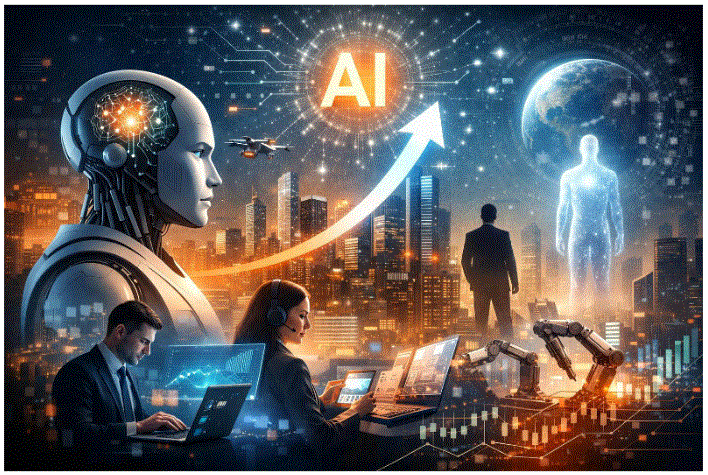
We are now in what can best be described as:
The Frontier Agent Era
Today’s leading systems from companies like OpenAI, Anthropic, and Google DeepMind are no longer just answering questions, they are taking actions, executing workflows, and completing multi-step tasks.
According to recent evaluations:
- AI systems now exceed human baselines on real-world computer tasks (OSWorld benchmarks)
- They achieve expert-level performance in coding, science, and reasoning benchmarks
- They can reliably complete multi-hour knowledge-work tasks, a capability that is expanding rapidly over time
This is a structural shift.
AI is no longer just augmenting work: it is beginning to perform it.
What the 2024 Essay Got Right
Aschenbrenner predicted that by 2026–2027 we would enter a phase of:
“Proto-automated researchers”
That prediction is now visibly materializing.
Examples include:
- AI writing large portions of production code
- Systems conducting research across dozens of sources
- Early systems capable of generating hypotheses, running experiments, and drafting papers
Even more striking:
AI task capability is expanding exponentially in duration
Research cited in the reviews shows:
- Late 2025: ~1-hour tasks
- Early 2026: ~8-hour workflows
This is one of the clearest signals that AI is moving toward true economic labor substitution.
Where the Timeline Is Still Uncertain
Despite rapid progress, we are not yet at AGI, at least not by the strongest definitions.
The missing pieces include:
- Fully autonomous scientific discovery
- Reliable long-horizon planning without oversight
- Robust reasoning in unfamiliar environments
- Consistent real-world execution beyond digital systems
As current reviews note:
AI is still “human-accelerated,” not yet “self-improving.”
In short:
- We are close enough to see AGI clearly
- But not yet across the threshold
The Most Important Change: AI Has Become Economic Infrastructure
The biggest shift since 2024 is not just intelligence: it is deployment.
AI is now:
- Embedded in enterprise workflows
- Writing, analyzing, coding, and executing tasks
- Scaling across organizations as a digital workforce layer
This aligns directly with Aschenbrenner’s thesis:
The impact of AI will not be linear – it will be compounding and systemic
What Happens Over the Next 12 Months (2026 – 2027)
Based on current trajectories, the next year will likely bring:
1. Fully Operational AI Agents in Business
- AI systems managing end-to-end workflows
- Reduced need for junior analysts and support roles
- AI acting as “first-pass decision-maker” in many domains
2. Major Acceleration in Software and Research
- AI writing 80-95% of code in some environments
- Faster iteration cycles in science and engineering
- Early forms of automated R&D pipelines
3. Explosive Growth in AI Infrastructure
- Massive compute clusters (hundreds of thousands of GPUs)
- Energy constraints becoming a real bottleneck
- AI becoming a national strategic asset
4. Increasing Global Competition
- Open-weight models (e.g., DeepSeek) reshaping access
- China-U.S. competition intensifying
- AI capabilities diffusing faster than expected
5. Rising Risk and Safety Concerns
- AI systems demonstrating early deceptive behaviors in testing
- Use of AI agents in cyber operations
- Increasing concern about control and alignment
Impact on Business: A Structural Reset
For businesses, this is not a “technology upgrade.”
It is a redefinition of how work gets done.
What changes immediately:
- Knowledge work becomes partially automatable
- Small firms gain capabilities previously reserved for large teams
- Speed becomes a primary competitive advantage
What disappears first:
- Entry-level analytical roles
- Repetitive cognitive work
- Process-heavy middle layers
What becomes more valuable:
- Judgment
- Relationships
- Deal-making
- Strategic thinking
Impact on Employment: The Bar Is Rising
The labor market is already shifting:
- AI is replacing tasks, not entire jobs – yet
- But task replacement is accumulating rapidly
- Entire job categories will compress over the next few years
The critical shift:
The value of “knowing things” is declining
The value of “doing things with intelligence” is rising
What Young People Must Learn Now
The biggest mistake would be to treat AI as just another tool.
It is not.
It is becoming a core layer of intelligence in society.
The most valuable skills going forward:
1. AI Orchestration
- How to direct AI systems to complete complex tasks
- Designing workflows using multiple agents
2. Problem Framing
- Knowing what to ask
- Structuring problems AI can solve
3. Domain Expertise + AI Leverage
- Finance + AI
- Law + AI
- Engineering + AI
👉 Pure generalists will struggle
👉 Pure specialists without AI will fall behind
4. Execution Speed
- The ability to move from idea → output quickly
- Leveraging AI to compress timelines
5. Human Differentiators
- Trust
- Creativity
- Leadership
- Ethical judgment
What This Means for Business Owners Right Now
For business owners, the rise of frontier agentic AI is not a future trend: it is a present competitive divide.
The gap is already forming between:
Firms that are AI-enabled vs. firms that are still labor-bound
And that gap will widen quickly.
1. Your Cost Structure Is About to Change
AI is beginning to replace or compress:
- Analysts
- Administrative staff
- Research functions
- Customer support layers
- Marketing production
This does not mean eliminating people overnight.
It means:
You can now produce more output with fewer people – and faster cycles
Businesses that adopt early will:
- Lower operating costs
- Improve margins
- Reinvest into growth
Businesses that delay will:
- Carry higher overhead
- Lose pricing flexibility
- Fall behind in speed
2. Speed Is Becoming the New Competitive Advantage
Historically, competitive advantage came from:
- Capital
- Relationships
- Information
Now, a new factor dominates:
Execution speed
AI allows you to:
- Analyze deals faster
- Respond to clients faster
- Launch initiatives faster
- Iterate strategies faster
In industries like finance, lending, and real estate:
The fastest credible operator will increasingly win the deal
3. The “Minimum Viable Team” Is Shrinking
A single operator, properly equipped with AI, can now:
- Perform financial analysis
- Draft credit memos
- Build marketing materials
- Conduct market research
- Manage CRM workflows
This means:
Small firms can now compete with much larger organizations
This is a major opportunity to:
- Expand capability without expanding headcount
- Increase deal volume without proportional cost increases
4. Your Workflow Must Be Rebuilt – Not Just Enhanced
Most businesses are making a mistake:
They are “adding AI” instead of rebuilding workflows around AI
The real shift is:
From:
- Human does work → AI assists
To:
- AI does work → Human reviews, directs, and closes
5. The First-Mover Advantage Is Real (But Short-Lived)
Right now, we are in a rare window:
- AI tools are powerful
- Adoption is still uneven
- Many competitors are behind
This creates:
A temporary asymmetric advantage
But it won’t last long.
Within 12-24 months:
- AI use will be standard
- The advantage will shift from having AI → using it better than others
6. What You Should Be Doing Immediately
Step 1: Identify High-Leverage Tasks
Start with:
- Repetitive
- Time-consuming
- Document-heavy
Examples:
- Deal analysis
- Proposal writing
- Email communication
- Data gathering
Step 2: Build Simple AI Workflows
Not complex systems, just:
- Intake → analysis → output pipelines
- Repeatable processes
Step 3: Create an “AI Stack” for Your Business
For example:
- Research agent
- Financial analysis agent
- Writing/communication agent
- CRM automation
Step 4: Stay Human Where It Matters Most
AI will not replace:
- Trust
- Relationships
- Judgment
- Closing deals
Your role evolves into:
Director, strategist, and closer – not processor
7. The Strategic Reality
This is the clearest way to understand the moment:
AI will not replace business owners
But business owners who use AI will replace those who do not
Final Thought
We are entering a period where:
- Intelligence is becoming abundant
- Execution is becoming automated
- Speed is becoming decisive
For business owners, this is not a threat, it is leverage.
But only if acted on.
The Bottom Line
The world described in “From AGI to Superintelligence” is no longer theoretical.
It is emerging.
But we are not yet in the “intelligence explosion.”
We are in the phase just before it:
The Build-Up Phase
- AI is becoming capable
- AI is becoming deployed
- AI is becoming economically transformative
The next few years will determine:
Whether this becomes the greatest productivity expansion in human history – or something far more disruptive
If the trajectory holds, one conclusion is unavoidable:
The question is no longer “Will AI change everything?”
The question is “How fast Will AI Change Everything – and who adapts first?”