What happens when propaganda is no longer confined to one country, one political movement or one war?
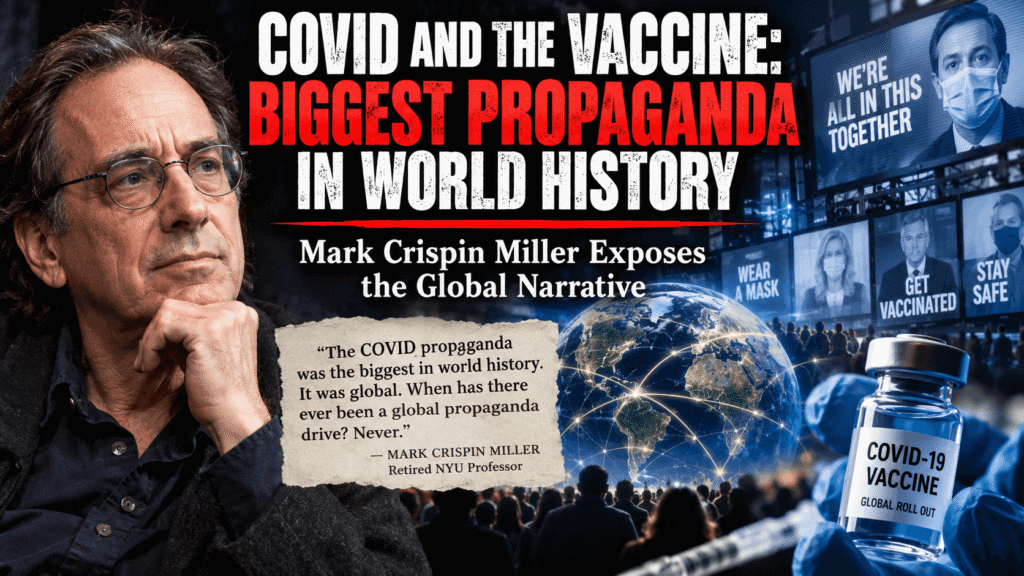
What happens when essentially the same message reaches billions of people around the world through governments, television networks, newspapers, corporations, universities, medical institutions and social media?
Retired New York University professor Mark Crispin Miller believes that is what happened during COVID-19.
Miller taught media studies and propaganda for decades. In a wide-ranging interview with USA Watchdog host Greg Hunter, he describes the response to COVID-19 and the worldwide vaccination campaign as something historically different from the propaganda campaigns that preceded it.
In Miller’s view, COVID was not simply a public-health crisis accompanied by government messaging. He argues that fear of the disease, masking, vaccination, censorship and the demonization of dissenters became components of an enormous international propaganda system.
Asked by Hunter just how large the campaign was, Miller does not hesitate:
“It was the biggest in world history. It was the biggest ever. It was global. When has that ever happened? When has there been a global propaganda drive? Never.”
That is an extraordinary claim.
Understanding why Miller makes it requires looking beyond the debate about whether particular COVID policies were right or wrong. His argument is about something larger: how fear can influence human behavior, how concentrated media can establish a dominant narrative, how educated professionals can become some of its strongest defenders, and how difficult it becomes for people to reconsider beliefs once they have emotionally and socially committed themselves to them.
“Unprecedented in Its Scope and Sophistication”
Miller’s central argument is that the COVID information campaign was unprecedented not merely because it was large, but because it was simultaneously global, coordinated in its messaging and psychologically powerful.
He tells Hunter:
“The propaganda is unprecedented in its scope and sophistication.”
In Miller’s interpretation, fear was the essential ingredient.
He argues that the public was presented with COVID as an extraordinary and potentially lethal threat, creating an atmosphere in which people became willing to accept measures they might otherwise have questioned.
Miller puts it much more forcefully:
“They had to create this myth that COVID was an unprecedented killer in order to get people so scared that they craved vaccination.”
This is one of several places where Miller’s interpretation needs to be separated from the “approved” facts. Miller disputes the conventional interpretation of those mortality figures and argues that death-certification practices exaggerated COVID deaths. His broader conclusion about the scale of COVID mortality is therefore his interpretation (shared by many), not an established conclusion presented by the interview.
His propaganda argument, however, extends beyond mortality statistics.
Miller asks readers and viewers to examine how the message was delivered.
“Wearing Is Caring”: The Power of Repetition
Miller uses masking as a simple example of how propaganda can become part of everyday life.
“Just consider masking alone. The propaganda for masking was inescapable. You’d be driving down the highway and you’d see a sign that says, ‘wearing is caring.’”
The significance, in Miller’s analysis, is not simply whether masks worked.
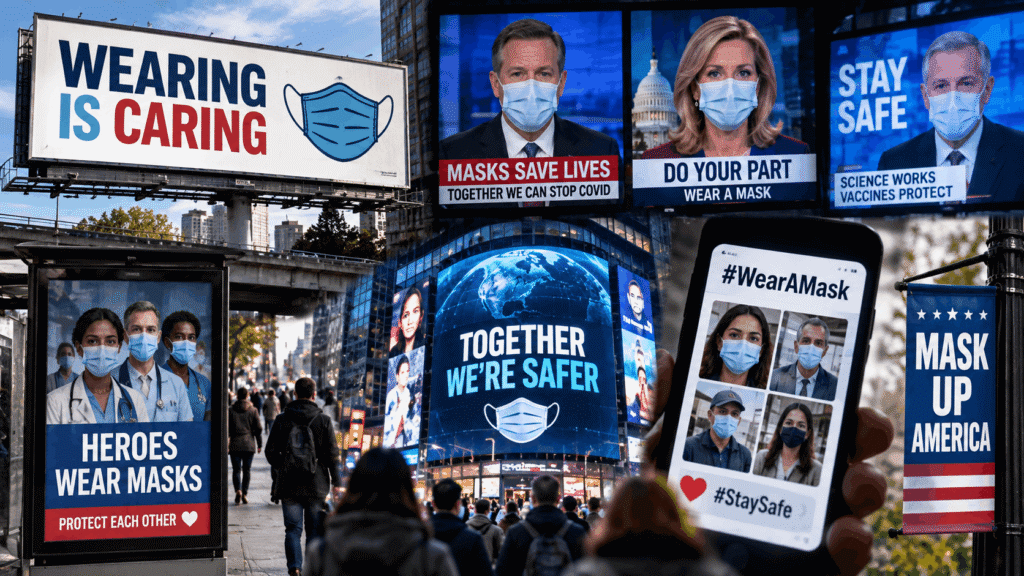
It is the saturation of the message.
Signs appeared in public places. Television personalities wore masks. Corporations adopted the same language. Schools and universities incorporated masking requirements into daily life. Government officials repeated similar messages.
For Miller, this illustrates one of propaganda’s fundamental techniques: repetition.
A message does not have to be delivered as an explicit political argument. It can become part of the visual and social environment until compliance itself becomes a signal of responsible behavior.
Masks therefore acquired meaning beyond their medical purpose.
To supporters, wearing one could represent responsibility and concern for others.
To critics, mandates became symbols of conformity and government control.
The phrase “wearing is caring” illustrates how effectively a complicated scientific and policy question could be transformed into a simple moral message.
China and the Global Information Environment
Miller also focuses on China’s role in the earliest stages of the pandemic.
He recalls dramatic videos circulated from China apparently showing people collapsing in public and argues that these images contributed to the initial atmosphere of fear.
“This was a propaganda drive that included China.”
He then connects that experience to something he has studied for decades: media concentration.
Modern communications allow images and narratives originating in one country to move almost instantaneously into another. A video appearing online can migrate into news reports, social-media feeds and political discussions around the world within hours.
That creates enormous possibilities for informing people.
It also creates enormous possibilities for manipulating them.
Why Media Concentration Matters
For Miller, one of the conditions making a worldwide propaganda campaign possible is the concentration of media ownership and influence.
“When you have a media system that is highly concentrated as ours is, there’s very little in the way of independent media, less and less as time goes on.”
This is an important part of his argument.
Propaganda is more difficult to sustain when numerous genuinely independent institutions compete to investigate the same claims.
But when information flows through a relatively small number of powerful institutions, Miller argues, a narrative can become extraordinarily difficult to escape.
He describes such a narrative as becoming almost “inescapable.”
Whether one accepts his conclusions about COVID or not, the structural question is worth considering.
A democratic society depends on competing sources of information. When governments, corporations, universities, media organizations and technology platforms reach similar conclusions at the same time, that may reflect a genuine consensus based on evidence.
But it can also make challenging that consensus extremely difficult.
The crucial question is whether dissent remains possible.
Propaganda Does More Than Repeat a Message
Miller says the COVID campaign involved another classic propaganda technique: demonizing dissenters.
“It also entails the demonization of people like you and me. Anyone who doesn’t go along with the narrative is evil.”
That is a powerful observation about the psychology of propaganda.
The strongest propaganda does not merely tell people what to believe.
It can tell them what kind of person they are if they believe it.
And it can tell them what kind of person their opponent is.
During COVID, disagreements about masks, lockdowns and vaccination frequently became moral judgments. People on one side saw themselves as protecting vulnerable neighbors. Some viewed people refusing vaccination as irresponsible or dangerous. On the other side, people who resisted mandates increasingly saw themselves as defending bodily autonomy and civil liberties.
Once disagreement becomes moralized, compromise becomes much more difficult.
The opponent is no longer merely mistaken.
The opponent becomes bad.
Miller’s Battle With NYU
For Miller, this was not an abstract academic debate.
He says he experienced it personally at NYU.
According to Miller, colleagues attempted to have him removed after he challenged prevailing COVID narratives and discussed masking in his propaganda class. He says he subsequently lost the ability to teach that course.
The irony is difficult to miss.
A professor who had spent decades studying propaganda says he was prevented from teaching propaganda while what he regarded as the largest propaganda campaign of his lifetime was taking place.
Miller believes his experience demonstrates why propaganda is so difficult to confront.
The problem, he says, is not primarily intellectual.
“It is not intellectually difficult. It’s fairly simple intellectually, but it’s very, very hard socially, and it’s very hard psychologically.”
That may be one of the most interesting observations in the entire interview.
Why Intelligent People Can Be Fooled
Miller rejects the comforting assumption that education makes people immune to propaganda.
In fact, he argues almost the opposite.
He points to professionals, academics, physicians, lawyers and other highly educated groups as particularly important in establishing and enforcing the COVID consensus.
He draws a provocative historical comparison, arguing that educated professionals have sometimes been enthusiastic supporters of propaganda campaigns in earlier periods as well.
His explanation is psychological.
Educated people may be confident in their ability to distinguish truth from manipulation. That confidence itself can become a vulnerability.
Miller says:
“You have to have an open mind. You have to be clear-sighted. You have to be willing to admit you were wrong. You have to be willing to admit you were fooled, because the propagandists are masters at this kind of thing.”
Miller includes himself in that warning.
Despite spending much of his career studying propaganda, he says he still discovers that things he once strongly believed were true may not have been.
That willingness to reconsider one’s own assumptions may be the most broadly applicable lesson of the interview.
Is the COVID Narrative Beginning to Change?
Miller believes something important has changed.
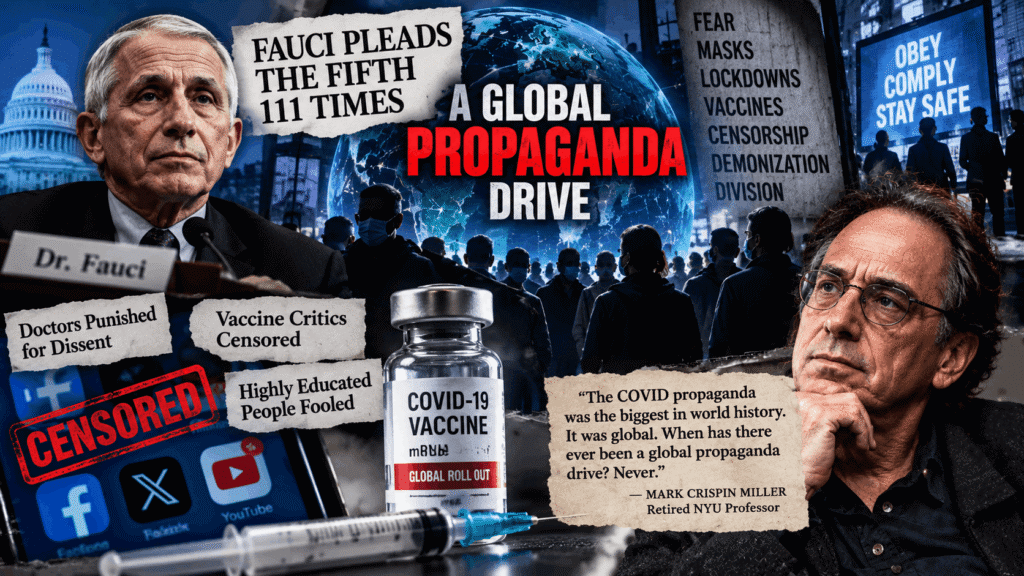
He points to recent legal disputes involving physicians who challenged COVID-era medical policies and to public figures who have reconsidered positions they took during the pandemic.
He interprets these developments as evidence that the consensus surrounding COVID policy is weakening.
Miller also discusses Anthony Fauci extensively, treating the former public-health official as a symbol of the larger system rather than its sole architect.
But Miller’s argument is ultimately not about one man.
“It’s not just about him. It’s about a whole medical colossus that is extraordinarily corrupt.”
That is Miller’s allegation, and it extends far beyond anything established by the interview itself.
But it identifies another important theme: institutional trust.
The question facing Americans after COVID is not simply whether Fauci, the CDC, FDA or pharmaceutical companies made mistakes – or outright lied.
Every institution makes mistakes.
The more difficult question is whether the systems designed to expose those mistakes worked effectively.
The Vaccine Debate Is Not Over
Hunter and Miller also discuss continuing promotion of COVID vaccines.
Miller regards current vaccination campaigns as a continuation of the original propaganda effort.
His criticism goes far beyond questions about particular vaccine risks. He alleges that the COVID vaccination campaign was part of a deliberate effort to harm or reduce the human population.
COVID vaccines have documented adverse effects, including cases of myocarditis and pericarditis associated with some mRNA vaccines. Those risks deserve transparent study and communication.
That is different, however, from demonstrating that vaccines were deliberately designed as a depopulation program.
The distinction matters.
One can demand investigation of vaccine injuries without assuming a deliberate extermination program. One can criticize pharmaceutical companies without assuming every medical institution is participating in a conspiracy. And one can question government COVID policies without denying that COVID itself caused serious illness and death.
Those distinctions are essential if society is ever going to understand this period clearly.
Eugenics and the Darker Argument
Miller nevertheless wants the COVID experience viewed through a much longer historical lens.
He discusses the eugenics movement of the late nineteenth and early twentieth centuries, its influence in the United States and Europe, and its eventual association with Nazi racial policies.
After World War II and the Holocaust discredited the term “eugenics,” Miller argues that some of its ideas survived under different terminology, including population control.
He specifically mentions the 1970s-era U.S. national-security discussion of population growth in developing nations.
From this history, Miller makes his most controversial claim: he interprets the COVID vaccination campaign as part of a modern depopulation agenda.
Again, history demonstrates that eugenics was real and that powerful institutions embraced it. That historical fact does not by itself establish Miller’s claim that COVID vaccination was a continuation of such a program.
But his historical argument raises a broader point worth remembering.
Prestigious institutions can be profoundly wrong.
Ideas can be labeled scientific and later be recognized as unethical or pseudoscientific.
Authority alone is therefore never sufficient proof.
Divide and Conquer
The discussion then moves from COVID into something broader: the extraordinary political and cultural division within modern society.
Miller sees this division as another mechanism of control.
“Every empire in human history has prevailed by dividing people. Divide and conquer.”
He points to divisions involving race, religion, political affiliation and COVID vaccination.
The pandemic produced another powerful fault line: vaccinated against unvaccinated, maskers against non-maskers.
Miller believes people need to resist that division.
This leads to one of the more unexpected portions of the interview.
Despite his anger over what happened to him, Miller explicitly argues against attacking people who took COVID vaccines or promoted them because they believed they were helping others.
He mentions celebrities who encouraged vaccination and says they should not simply be hated or blamed.
“We don’t punish or hate the people who fell for this.”
Whatever readers think about Miller’s larger conclusions, this part of his argument deserves attention.
If propaganda works partly by dividing people into hostile camps, continuing to hate one another simply perpetuates the mechanism.
A Call for Medical Help
Hunter argues that people suffering health problems they associate with COVID vaccination need treatment and asks whether the issue should be treated as a national emergency.
Miller agrees.
He says he intends to raise the idea with Robert F. Kennedy Jr., whom he says he knows.
Miller is not a physician, and he explicitly acknowledges that during the discussion. The interview refers listeners to doctors who advocate treatments for what they describe as vaccine injury.
People experiencing medical problems after vaccination deserve serious evaluation. Treatment decisions should be based on individual medical circumstances and reliable clinical evidence.
The broader issue Miller raises, however, is harder to dismiss: patients who believe they have been injured should be heard rather than ridiculed.
“Reading the World”
The interview ends by returning to Miller’s life’s work.
His wife is directing a documentary about him called Reading the World: The Life and Times of Mark Crispin Miller.
Miller describes a career that began with the close reading of poetry and literature, expanded into movies and advertising, and eventually moved into political communication and propaganda.
The common thread is learning to examine what is placed in front of us rather than simply absorbing it.
Miller says the film documents both that intellectual journey and the personal costs he says he has paid for publicly challenging accepted narratives.
His closing message is simple:
“The most important thing is that we grasp propaganda, and we learn to read it, and we learn to see through it.”
That lesson extends well beyond COVID.
The Hardest Part of Propaganda Is Admitting We Were Fooled
Perhaps the deepest insight in Miller’s interview has little to do with vaccines.
It concerns human nature.
Propaganda works because people want coherent explanations. We trust institutions. We trust people who share our values. We trust experts whose credentials reassure us. We repeat information accepted by our social group.
And after publicly committing ourselves to a position, changing our minds can become painful.
That applies to everyone.
It applies to people who trusted every government pronouncement during COVID.
It also applies to people who now assume that every alternative explanation must therefore be true.
Miller’s own standard provides a useful test:
“You have to be willing to admit you were wrong. You have to be willing to admit you were fooled.”
That principle cannot apply only to the other side.
If the COVID period is eventually to be understood rather than endlessly fought over, official institutions should be willing to acknowledge mistakes and release evidence that allows their decisions to be scrutinized.
Critics should be equally willing to abandon claims that evidence does not support.
Journalists should investigate rather than protect narratives.
Scientists should be free to disagree.
And citizens should resist the temptation to treat disagreement as evidence of evil.
COVID May Be a Case Study for Generations
Mark Crispin Miller calls COVID and the vaccination campaign the largest propaganda operation in world history.
History will have to judge it.
But the extraordinary worldwide information environment created during COVID deserves serious study regardless of where one stands on vaccines, lockdowns or public-health policy.
Billions of people experienced the same crisis simultaneously.
Governments adopted extraordinary powers. Pharmaceutical companies produced medical products at unprecedented speed. Social-media platforms became arbiters of permissible medical discussion. Scientists became political figures. Neighbors argued with neighbors. Families divided over vaccination. Institutions decided which information constituted misinformation while the underlying science was still developing.
That combination may indeed make the COVID era one of the most important case studies in mass persuasion ever available to scholars.
The lesson should not simply be “never trust government.”
Nor should it be “trust the experts.”
The more useful lesson is harder.
Learn how propaganda works. Demand evidence. Examine who benefits. Protect genuine scientific disagreement. Question extraordinary claims regardless of who makes them. And remain willing to discover that something you strongly believe may be wrong.
That is what Miller means by learning to “read the world.”
And in an age of artificial intelligence, algorithmic media, concentrated communications power and increasingly sophisticated persuasion, learning how to do that may be more important now than ever.
See the posting on USA Watchdog.com