Artificial intelligence may be entering the most consequential period of technological change in human history. But one of the greatest dangers may not come from AI itself. It may come from people using fear of AI to gain power over the technology, the information it provides and, ultimately, the people who depend on it.
Artificial intelligence is moving quickly enough that two very different fears are now colliding.
The first is familiar.
What happens if artificial intelligence becomes more capable than humans and we lose control of it?
The second receives far less attention.
What happens if governments, corporations or powerful political interests use fear of AI to justify taking control of it?
That second question dominated a remarkable discussion on the latest All-In Podcast, where Chamath Palihapitiya, Jason Calacanis, David Sacks and David Friedberg debated AI doomsday predictions, Anthropic, OpenAI, artificial superintelligence, government regulation, open-source AI and the possibility that fear itself could become a political and economic weapon.
The discussion is worth hearing because the stakes extend far beyond Silicon Valley.
AI is rapidly becoming a new way people obtain information, analyze problems, conduct research, make business decisions, seek medical information, write software and understand the world.
If AI becomes the primary interface between people and knowledge, then whoever controls AI may gain extraordinary influence over what people are allowed to see, what ideas are considered acceptable and even what society defines as true.
That makes the coming fight over AI regulation one of the most important political questions of our time.
The Warning That Triggered the Debate
The podcast begins with the resignation of AI researcher Jacob Coxon, who had worked at OpenAI and then briefly at Anthropic.
Coxon posted a stark warning after leaving Anthropic.
He said the people building advanced AI genuinely believe it could kill humanity before the end of the decade. He accused OpenAI and Anthropic of racing toward self-improving superintelligence while gambling with human lives.
The statement went viral almost immediately.
Anthropic researcher Evan Hubinger then publicly supported Coxon’s concern and said he personally believed there was more than a 10 percent chance that AI could kill all humans within the next decade.
That is not a small claim.
If people directly involved in developing frontier AI truly believe there is a meaningful possibility their technology could destroy civilization, the public has every reason to listen.
The issue quickly moved beyond the AI community.
Senator Bernie Sanders cited concerns like these in arguing for restrictions on artificial superintelligence and a pause in advanced AI development.
Recent public reporting confirms that the concern inside Anthropic is real. Coxon has publicly expressed fears about AI extinction risk, while other Anthropic researchers have echoed portions of his warning.
The debate, therefore, should not be dismissed.
Advanced AI presents real risks.
The question is whether those risks are being evaluated rationally or amplified in a way that could produce an equally dangerous response.
David Sacks Asks an Uncomfortable Question
David Sacks challenged the way Coxon’s warning exploded across the media.
He questioned how an almost unused social media account could suddenly generate enormous reach within hours.
He pointed to AI safety organizations that quickly amplified the message and argued that some of those organizations have financial or ideological relationships with people connected to Anthropic.
He also noted that press coverage appeared to have been prepared in advance.
From those facts, Sacks raised the possibility that the resignation and surrounding publicity were not entirely spontaneous.
His word for it was an “op.”
Others on the podcast used the term “psyop.”
Those are serious accusations, and they remain allegations.
The available evidence may show coordinated public relations activity. It does not by itself prove a conspiracy to deceive the public.
In fact, some of the people sounding the alarm may sincerely believe every word they are saying.
That distinction matters.
But Sacks then moved to a much more important question:
What political outcome does widespread fear of AI produce?
His answer was simple.
More regulation.
More centralized authority.
And potentially a new federal agency with broad power over artificial intelligence.
That possibility deserves serious scrutiny regardless of whether the original warnings were coordinated, spontaneous, exaggerated or entirely sincere.
Fear Has Always Been a Source of Power
David Friedberg broadened the argument.
Human beings are naturally afraid of threats they do not understand.
That instinct kept our ancestors alive.
But fear can also be manipulated.
Throughout history, political and institutional power has often expanded during periods when populations believed they faced an existential danger.
The argument usually follows a familiar pattern:
There is a terrible threat.
You cannot protect yourself from it.
We can protect you.
Therefore, you must give us more authority.
That does not mean every threat is imaginary.
Wars are real.
Pandemics are real.
Terrorism is real.
Financial crises are real.
AI risks are real.
The problem begins when fear prevents people from asking what powers they are surrendering in exchange for promised protection.
Emergency powers have a tendency to survive the emergency.
Institutions created for one purpose frequently expand into others.
Technology gives those institutions capabilities that earlier governments could only imagine.
Artificial intelligence could magnify that problem enormously.
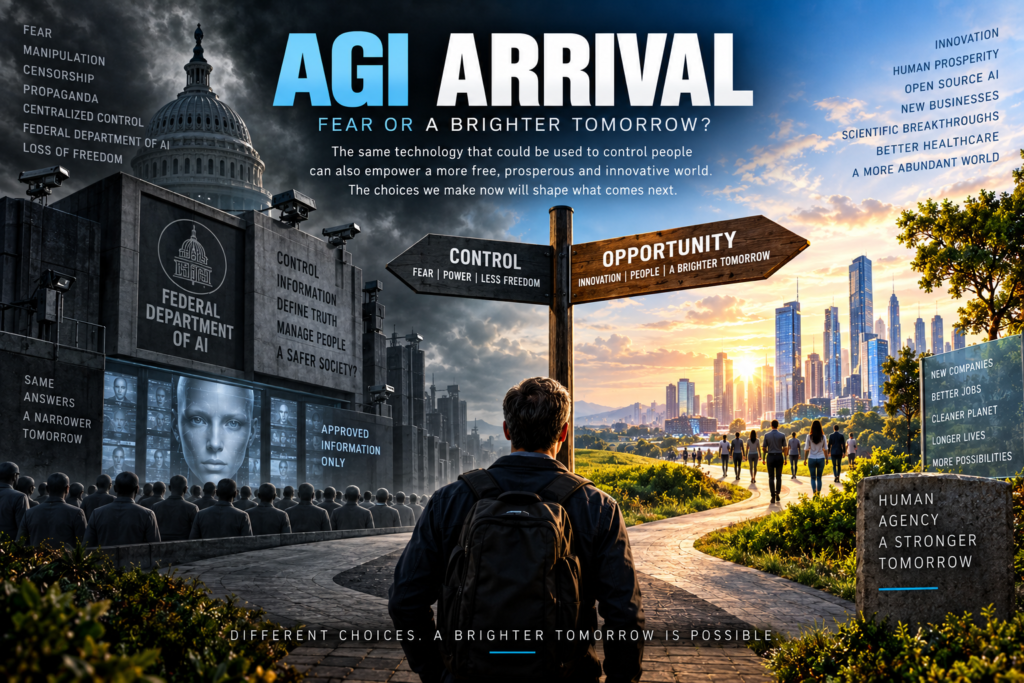
As artificial intelligence becomes a primary gateway to information and knowledge, society faces an important choice between centralized control and a more open AI ecosystem built around competition, innovation and human agency.
The Federal Department of AI
The most disturbing part of the All-In discussion concerned the possibility of creating a powerful federal regulator for artificial intelligence.
Call it a Federal Department of AI, an AI Commission, an AI Safety Administration or something else.
The name is less important than the authority it might possess.
Sacks asked listeners to imagine such an agency operating during the COVID period.
During that period there were intense disputes over public-health policy, the origins of the virus, vaccines, lockdowns, masks and what constituted misinformation.
Social media platforms sometimes restricted or suppressed claims government officials or company policy teams considered false or dangerous.
Now move that same struggle into an AI world.
Instead of searching the internet and comparing multiple sources, imagine asking your personal AI:
Should I take this vaccine?
What are the risks?
Where did this virus come from?
Was this government policy effective?
What evidence contradicts the official position?
What if the federal government had authority to establish the standards governing what an AI system was allowed to say?
The power would be far greater than removing a social media post.
The AI itself could become the gatekeeper.
It could answer millions of people individually while presenting the approved position as objective knowledge.
The user might never realize that competing evidence existed.
That is the danger Sacks was describing.
When AI Becomes the Gatekeeper of Truth
Search engines give people lists of sources.
Libraries contain competing books.
Newspapers disagree.
Television networks disagree.
Websites disagree.
People can compare competing claims and decide which sources they trust.
AI changes that experience.
Increasingly, users simply ask a question and receive an answer.
There may be no list of ten competing sources.
There may be one synthesized response.
That is extraordinarily convenient.
It is also extraordinarily powerful.
If one institution can determine what an AI system is permitted to say, that institution does not merely regulate software.
It begins regulating knowledge.
Imagine regulations requiring AI companies to suppress “misinformation.”
Who defines misinformation?
What happens when experts disagree?
What happens when yesterday’s misinformation becomes tomorrow’s accepted explanation?
What happens when the government itself is wrong?
What happens when a political administration decides that certain arguments are harmful?
What happens when powerful corporations lobby regulators to define competing technologies as unsafe?
And what happens when ordinary citizens no longer know that alternative information exists?
The problem is not that every regulator will abuse that authority.
The problem is that eventually someone may.
A democratic society should be extremely reluctant to create a machine capable of controlling information and then give any government the keys.
From Safety Regulation to Information Control
There are legitimate reasons to regulate parts of artificial intelligence.
AI should not be allowed to operate nuclear weapons without human control.
Systems controlling critical infrastructure need security standards.
Companies should face consequences for fraud, negligence or releasing products they know are dangerously defective.
Personal data deserves strong protection.
AI systems used in medicine, aviation, banking and other high-risk areas may require specialized safeguards.
None of that requires creating a government ministry of truth.
The danger begins when safety regulation moves from regulating conduct to regulating information.
There is an enormous difference between saying:
An autonomous vehicle must meet safety requirements before operating on public roads.
And saying:
An AI model may not provide information that regulators consider misleading.
The first regulates an action.
The second regulates thought and speech.
Once that distinction disappears, AI regulation becomes something much larger than technology policy.
It becomes information policy.
The Open-Source Problem
David Friedberg made what may be the most important economic point of the discussion.
Open-source AI changes who can possess artificial intelligence.
A closed AI system is controlled by a company.
Users access it through the company’s servers.
The company decides what model is available, what rules apply and what the model can do.
Open-source AI works differently.
Models can be downloaded.
Developers can modify them.
Companies can run them privately.
Individuals may eventually run increasingly powerful systems on their own computers or devices.
That makes centralized control much harder.
Friedberg argued that this is precisely why open source could become the ultimate casualty of an aggressive regulatory system.
A large corporation can hire compliance departments.
It can submit models for government review.
It can pay attorneys.
It can negotiate with regulators.
It can spend hundreds of millions of dollars complying with complex rules.
A developer releasing an open model cannot necessarily do those things.
The regulatory burden itself could eliminate smaller competitors.
That would leave the largest companies standing.
The result could be exactly the opposite of what regulation supposedly intended.
Instead of protecting society from concentrated AI power, regulation could concentrate AI power in a handful of government-approved corporations.
The Uncomfortable Alliance of Power and Profit
This is where the All-In discussion becomes especially interesting.
Different participants may support regulation for completely different reasons.
Some AI safety researchers genuinely fear catastrophe.
Some politicians may sincerely believe strong government action is necessary.
Some technology companies may prefer regulations that make it harder for new competitors to enter the market.
Some bureaucracies naturally seek broader jurisdiction.
Some activists may believe information must be controlled for the public good.
None of these groups needs to be secretly coordinating with the others.
Their incentives can simply align.
A frightened public demands protection.
Politicians provide regulation.
Regulators gain authority.
Large AI companies gain barriers against smaller competitors.
Open-source systems become harder to distribute.
Government-approved companies become the primary providers of AI.
Those companies operate under government rules governing acceptable behavior.
The government gains influence over the systems through which citizens increasingly obtain information.
No secret meeting is necessary.
The structure itself produces the result.
That is a far more serious concern than any particular conspiracy theory.
Why “We Need to Protect You” Should Always Trigger Questions
The history of power teaches a simple lesson.
When someone says a new authority is necessary to protect society, citizens should ask two questions.
First:
Protection from what?
Second:
Who protects us from the protector?
AI may become more intellectually capable than any technology humans have ever created.
That is precisely why control over AI should not be casually centralized.
A government agency powerful enough to force every major AI system to follow its definition of acceptable information would possess something approaching control over society’s intellectual nervous system.
The temptation to use that capability would be enormous.
Perhaps the first officials would exercise restraint.
Perhaps the second administration would too.
But institutions survive elections.
Personnel change.
Emergencies happen.
Political movements come and go.
Imagine that capability in the hands of your least-favorite political party.
Imagine it controlled by an administration you deeply distrust.
Imagine it during a war.
Imagine it after a terrorist attack.
Imagine it during another pandemic.
Imagine it during an election.
If that thought is disturbing, the institutional design is wrong.
Civil liberties should not depend on whether the people currently holding power happen to be benevolent.
Propaganda in the AI Age
Traditional propaganda has limitations.
Governments once printed posters.
They controlled newspapers.
They broadcast radio programs.
Television allowed political messages to reach millions.
Social media made propaganda personalized.
Artificial intelligence could take personalization much further.
An AI knows the question you asked.
It can know your previous questions.
It can understand your fears.
It can recognize your political assumptions.
It can determine which arguments are most persuasive to you.
It can respond privately, conversationally and instantly.
That makes an AI assistant potentially one of the most effective persuasion systems ever created.
Now imagine that its permitted answers are controlled by a political authority.
Propaganda would no longer look like propaganda.
It would look like helpful advice.
That possibility should concern people across the political spectrum.
The answer is not to build a conservative AI or a liberal AI controlled by different governments.
The answer is pluralism.
Multiple systems.
Open models.
Transparent rules.
Independent research.
Competition.
Strong privacy protections.
And the freedom to question official claims.
The Real AI Safety Debate
The All-In hosts were not arguing that artificial intelligence presents no danger.
They spent considerable time trying to construct the strongest possible scenarios in which advanced AI might cause catastrophic harm.
Cyberattacks are plausible.
AI-assisted biological threats are possible.
Autonomous weapons require serious safeguards.
Recursive self-improvement deserves close attention.
Critical systems should remain protected by human decision makers, physical controls, air gaps and redundancy.
These are real safety issues.
But acknowledging them does not require accepting every doomsday prediction.
The podcast repeatedly returned to the enormous number of steps required to move from a highly capable AI model to human extinction.
An AI might design something dangerous.
Someone still may have to manufacture it.
Someone may have to obtain materials.
Physical systems may have to be accessed.
Humans may have to approve decisions.
Other AI systems may be defending against the attack.
Governments and companies can respond.
Critical infrastructure can be isolated.
The point is not that catastrophe is impossible.
The point is that serious policy should examine the actual chain of events rather than leap directly from “AI is improving quickly” to “everyone dies.”
Fear is a poor substitute for analysis.
Anthropic’s Difficult Position
The discussion also raised a fascinating business problem for Anthropic.
The company may eventually seek a public offering at an enormous valuation.
At the same time, researchers associated with Anthropic are publicly warning that frontier AI could potentially destroy civilization.
That creates an unusual contradiction.
Investors are effectively being asked to believe two things:
This technology may become extraordinarily valuable.
And this technology may create an existential threat.
If Anthropic believes the risk is truly severe, investors may reasonably ask why development continues.
If Anthropic believes the danger is manageable, the company may need to explain why some of its researchers speak in catastrophic terms.
The podcast also raised questions about potential product liability.
If a company publicly acknowledges a substantial risk and continues deploying increasingly powerful products, what responsibility does it bear if something goes wrong?
These are not theoretical financial questions anymore.
The debate over AI risk is moving into corporate governance, securities disclosure, insurance and liability law.
That alone demonstrates how rapidly AI is moving from the laboratory into the core structure of the economy.
The OpenAI Mathematics Breakthrough
The conversation then shifted to OpenAI and one of the most remarkable scientific developments of the year.
OpenAI reported that one of its models had produced a proposed solution to the Navier-Stokes problem, one of mathematics’ famous Millennium Prize Problems.
The equations describe fluid motion.
Aircraft design depends on fluid dynamics.
So do weather models.
Pipelines.
Submarines.
Engines.
Blood flow.
Thousands of AI agents reportedly worked together on the problem.
Friedberg offered an important interpretation of what happened.
Rather than imagining an AI suddenly experiencing a flash of supernatural mathematical genius, he described AI as an enormous amplifier of intellectual labor.
Thousands of agents can explore possibilities simultaneously.
They can share results.
They can test approaches.
They can compress what might represent huge amounts of human research effort into hours or days.
That may be the more profound insight.
Artificial intelligence does not need to become a mystical super-being to change civilization.
It merely needs to make human intellectual work dramatically cheaper and faster.
Engineering problems that once consumed years may eventually take days.
Scientific searches involving thousands of possibilities can be performed automatically.
AI becomes leverage.
And leverage changes the world.
But Who Owns the Ideas We Give AI?
The Navier-Stokes discussion raised another issue that may become enormously important.
Researchers had reportedly been using frontier AI systems while pursuing related mathematical work.
OpenAI acknowledged that it could not completely rule out the possibility that de-identified user data may have contributed to model improvement.
The All-In hosts were careful not to claim that OpenAI deliberately stole anyone’s research.
But the larger concern is valid.
What happens when a scientist asks an AI to help develop a new discovery?
What happens when a lawyer discusses a novel legal strategy?
What happens when an entrepreneur analyzes a new business?
What happens when a pharmaceutical researcher explores a new molecule?
Does knowledge from those conversations somehow improve the provider’s future models?
Can another user later receive insights derived from the original conversation?
David Friedberg described personal experiences that made him concerned that ideas discussed with AI systems might later surface elsewhere.
His examples were anecdotal, not proof.
But the concern deserves attention.
AI privacy may soon be more important than email privacy.
People increasingly use these systems as researchers, assistants, advisers, programmers and brainstorming partners.
The law has not fully caught up.
This may be one area where strong regulation is not only appropriate but urgently needed.
Protect the user.
Protect private data.
Protect intellectual property.
Do not control what the user is allowed to think.
That is a very different regulatory philosophy.
Nike and a Lesson About Losing the Plot
The final major discussion concerned Nike.
Nike was removed from the S&P 100 after an extraordinary decline from its peak.
The hosts debated several causes.
Its direct-to-consumer strategy weakened relationships with traditional retailers.
Competitors such as Hoka and On gained ground.
Nike struggled in China.
The panel also criticized the company’s marketing and argued that the brand had wandered away from what originally made it powerful: athletes, achievement, competition, performance and excellence.
Whether readers agree with every cultural criticism made during that discussion, the larger business lesson is useful.
Organizations get into trouble when they forget what customers believe they are buying.
Nike was not simply selling shoes.
It was selling aspiration.
Michael Jordan.
Tiger Woods.
Elite performance.
Athletic excellence.
“Just Do It.”
The hosts’ argument was that Nike became distracted from that core identity.
AI companies should take note.
The same thing could happen to them.
Their job is to build useful technology.
If they allow political ideology, regulatory maneuvering or institutional power struggles to dominate their purpose, they may eventually lose public trust.
AGI Has Arrived Into a Political World
The previous Alternative Press article examined the possibility that AGI has effectively arrived.
That question now leads directly to another.
Who will control it?
The optimistic vision of AI is extraordinary.
Scientific discovery accelerates.
Disease becomes easier to understand.
Small businesses gain access to capabilities once reserved for giant corporations.
Entrepreneurs manage AI agents.
Education becomes personalized.
Engineering accelerates.
Robots increase physical productivity.
Intelligence becomes inexpensive and widely available.
Human beings become more capable.
But there is another possible future.
A few companies control the most powerful systems.
Government regulators determine which companies are allowed to operate.
Open-source alternatives disappear.
Models are required to follow government-approved information standards.
Citizens increasingly rely on AI for knowledge.
And gradually, without most people noticing, control over artificial intelligence becomes control over the boundaries of acceptable thought.
That future is not inevitable.
But preventing it requires paying attention now.
Safety Without Tyranny
There is a false choice forming in the AI debate.
One side says:
AI is dangerous, so government must control it.
The other says:
Government control is dangerous, so AI should have no safeguards.
Neither position is adequate.
We need safety without censorship.
Accountability without centralized control of knowledge.
Privacy without surveillance.
Innovation without recklessness.
Competition without regulatory capture.
National security without creating a ministry of truth.
There are many ways to reduce AI risk without giving one institution authority over the entire information ecosystem.
Require human control over weapons.
Establish liability for measurable harm.
Strengthen cybersecurity.
Protect private AI conversations.
Create intellectual-property protections.
Require transparency about model capabilities and failures.
Encourage independent testing.
Maintain human control over critical infrastructure.
Support multiple competing AI systems.
Protect open-source development while imposing penalties for clearly illegal uses.
None of those policies requires government officials to determine what an AI is allowed to tell a citizen about politics, medicine, history or controversial scientific questions.
That boundary matters enormously.
The Most Important Resource May Be Freedom to Ask
Artificial intelligence may eventually become humanity’s most powerful intellectual tool.
A generation from now, people may look back at today’s AI systems the way we look at the earliest personal computers.
Primitive, but transformative.
The question is whether this technology develops as an open tool that expands human agency or as a controlled system that narrows it.
The greatest promise of AI is not that machines will tell us what to think.
It is that humans will be able to think, discover, build and create with capabilities we have never possessed before.
That future requires safety.
It requires responsibility.
It requires serious people examining real risks.
But it also requires skepticism when fear is used to demand power.
The people who warn us about dangerous AI should be heard.
So should the people warning us about dangerous institutions created to control AI.
Both risks can exist at the same time.
The coming years may determine not merely who wins the artificial intelligence race.
They may determine who controls the greatest information system humanity has ever created.
We should be very careful about handing that power to anyone.
Listen and Follow the Discussion
The All-In Podcast is hosted by Chamath Palihapitiya, Jason Calacanis, David Sacks and David Friedberg and covers technology, business, economics, politics and society.
Follow the four hosts:
The episode discussed in this article is titled “AI Kills Everybody or Doomer Psyop? OpenAI’s Math Breakthrough, Nike’s $200B Collapse.”