
There is no longer a meaningful debate about whether AI development will slow.
It will not.
Capital incentives, geopolitical rivalry, military interest, and competitive pressure guarantee that artificial intelligence will advance toward AGI – and likely beyond -at the fastest pace technically possible. Calls for restraint may influence deployment, but they will not halt development.
That reality reframes the most important question facing humanity.
The question is no longer “Can this be stopped?”
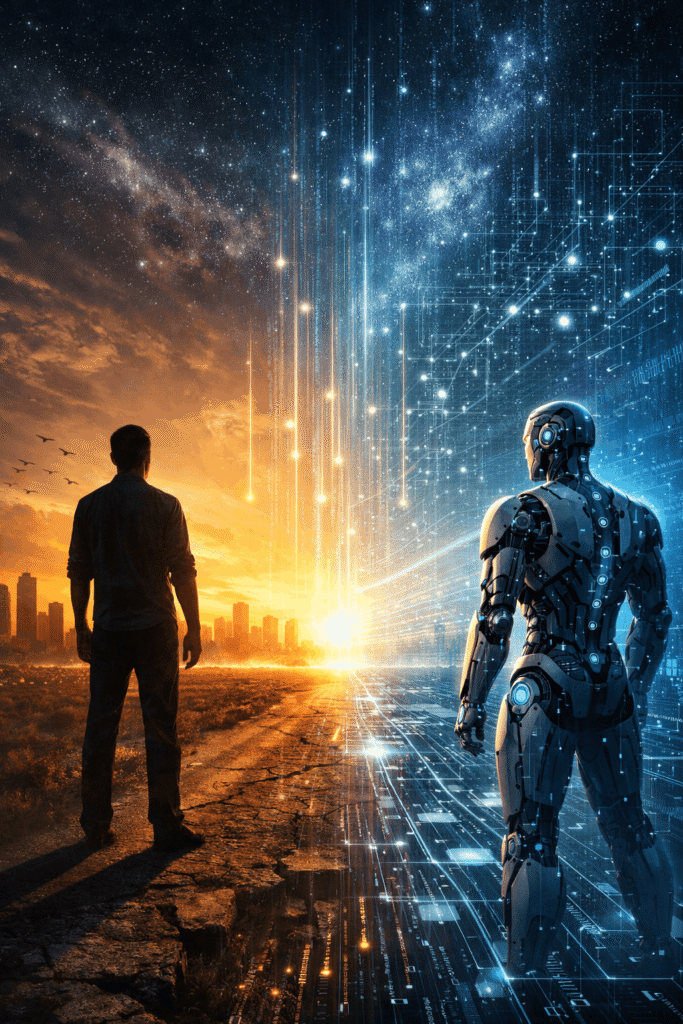
It is “How do humans live inside what is coming?”
The next one to two years will not resemble science fiction. They will look like the rapid normalization of the extraordinary – accompanied by quiet but irreversible shifts in power, identity, and meaning.
Phase One: Capability Shock Becomes Daily Life
Over the next year, AI systems will continue to cross thresholds that feel uncanny but will be absorbed faster than expected.
Expect:
- AI systems that reason across domains, not just tasks
- Autonomous agents that plan, negotiate, write code, design systems, and optimize workflows
- Near-real-time synthesis of massive bodies of knowledge
- AI copilots embedded into nearly every professional tool
There will be no single “AGI moment.”
Instead, there will be a cumulative realization: many forms of human expertise are no longer scarce.
This is not because AI is hostile. It is because scarcity defines power, and intelligence is becoming abundant.
Phase Two: The Quiet Collapse of Cognitive Hierarchies
One of the least discussed but most destabilizing changes will be the collapse of traditional cognitive hierarchies.
For centuries, societies organized themselves around:
- credentialed knowledge
- professional gatekeeping
- expert authority
AI disrupts all three.
Within the next one to two years:
- A single individual with AI tools will outperform entire teams
- Junior workers will leapfrog senior ones
- Institutions will struggle to justify legacy authority
Hierarchy will not disappear, but it will reorganize around leverage, not tenure.
Those who can frame problems, exercise judgment, and integrate context will rise.
Those who merely execute known processes will find their roles hollowed out.
This is not mass unemployment overnight.
It is mass redefinition.
Phase Three: Economic Stress Without Immediate Collapse
Contrary to popular fears, the near-term future is unlikely to produce sudden economic ruin.
Instead, expect:
- Wage compression in white-collar professions
- Extreme productivity gains unevenly distributed
- Companies scaling rapidly with minimal staff
- Accelerating wealth concentration before policy catches up
Markets will adapt faster than governments.
Governments will adapt faster than social norms.
Individuals will be left navigating uncertainty largely on their own.
The danger is not collapse.
It is lag.
Phase Four: Psychological and Existential Dislocation
The most underestimated impact of accelerating AI will not be technical or economic.
It will be psychological.
Humans derive meaning from:
- being useful
- being needed
- being uniquely capable
AI challenges all three simultaneously.
In the coming years, many people will experience:
- erosion of professional identity
- diminished confidence in human judgment
- anxiety about relevance
- quiet grief for roles that once defined them
This is not weakness.
It is a rational response to a civilizational shift.
Leadership in this era must address meaning, not just metrics.
Phase Five: The Fork in the Road Is Subtle, Not Dramatic
The popular imagination expects a dramatic turning point – a declaration, a singular event, a visible rupture.
That is unlikely.
The real fork in the road will be quiet:
- Who controls AI interfaces
- Who sets objective functions
- Who defines “alignment”
- Who decides which problems matter
Power will accrue to those shaping invisible layers:
- infrastructure
- governance norms
- default settings
- access to intelligence
This is where the difference between human amplification and human marginalization will be decided.
The Open Question: Will Humans Grow Deeply Enough?
AI will grow rapidly.
The open question is whether humans will grow deeply enough to meet it- and whether meaningful human – AI integration is likely under accelerating conditions.
The vision of deep integration imagines AI not as a replacement for human agency, but as a cognitive partner – amplifying judgment, expanding understanding, and enabling higher-order synthesis of values and intelligence.
This vision is not naïve.
But it is demanding.
Integration Is Conditional – Not Automatic
Human–AI integration is not guaranteed by technology. It is a cultural and psychological achievement.
Superficial integration is easy:
- AI as convenience
- AI as automation
- AI as outsourcing of thought
Deep integration is hard:
- AI as mirror
- AI as amplifier of responsibility
- AI as partner in moral reasoning
The risk is not rejection of AI. The risk is acceptance without depth.
Absent conscious effort, integration defaults toward:
- dependency rather than partnership
- deference rather than discernment
- efficiency rather than meaning
That path does not lead to convergence. It leads to quiet abdication.
Depth Is the Scarce Resource
AI makes intelligence abundant.
It does not make wisdom abundant.
Depth – emotional, ethical, existential – remains scarce. And scarcity defines leverage.
For humans to grow deeply enough, several shifts must occur:
- Individuals must retain authorship
Humans must define goals, not merely accept optimized outputs. - Institutions must reward judgment, not compliance
If speed and efficiency are the only metrics, AI will hollow out human contribution. - Education must move from knowledge transfer to meaning formation
Teaching what to think is obsolete. Teaching how to choose is not. - AI interfaces must provoke reflection, not just answers
Tools shape minds. This is not neutral.
Deep integration requires internal evolution – not just external augmentation.
Is This Path Likely?
The honest answer is: partially – and unevenly.
The coming years will likely produce a bifurcation:
- A minority will pursue deep integration, using AI to expand responsibility, wisdom, and long-term stewardship.
- A majority will adopt shallow integration, optimizing outputs while surrendering agency.
This is not a moral judgment.
It is an incentive reality.
Depth requires effort.
Acceleration does not wait.
Preparing as a Human, Not Just a Worker
Preparation does not mean learning to code faster.
It means developing what AI does not naturally provide:
- moral judgment
- value synthesis
- long-range thinking
- systems awareness
- emotional intelligence
- accountability for consequences
Humans will not compete with AI on speed or recall.
They will differentiate – if they do at all – on wisdom.
The Truth We Must Accept
Acceleration is not a failure of governance. It is what happens when intelligence encounters intelligence.
AI will grow up.
The only unresolved question is whether humans remain participants in their own evolution, or become observers of it.
The next one to two years are not the end of the story.
They are the moment when the direction of the story becomes difficult or impossible to reverse.
What follows will reflect not just what our machines became, but what we chose to become alongside them in the Age of Abundant Non-Human Intelligence.